China Crisis’s ‘Autumn in the Neighbourhood’

China Crisis is a band that these days only of people of a certain age – often already with grandchildren – remember. It’s the temporal equivalent of my grandfather telling me about Glen Miller. The ones that do remember them are usually those slightly nerdish fellows that were aware what was going around in the nether-regions of the charts: China Crisis’ most successful single in the UK was the moody ‘Wishful thinking’, peaking at number 9.

Their first three albums nevertheless all sold enough for two gold and a silver disc. Who would have thought. I never really followed them or got into them as a young person, but once I turned old and my body made the natural, genetic progression to Steely Dan devotee, my overall taste in music, sensitised by The Dan, changed.

When Walter Becker died, I looked up his Wikipedia entry and was surprised that he had produced more than Steely Dan and Donald Fagen: two of China Crisis’s albums were on that list. That sounded intriguing: a mix of Becker’s perfectionist approach to studio production and his peculiar musical signatures mixed with with the Liverpudlian spirit of China Crisis seemed an interesting mix, and indeed: ‘Flaunt the imperfection‘ is one of the best produced and (more importantly) beautiful albums I had heard in quite some time. The rest of their back catalogue from the eighties and nineties is not quite as stunning as ‘Flaunt the imperfection’ though still contains some beautiful songs. It’s nevertheless their 2015 album ‘Autumn in the Neighbourhood’ which is their crowning glory: crowdfunded via the now bankrupt Pledgemusic, its production is impossibly polished, layered and sound more like a Steely Dan album than anything else. Musically it sounds like the Becker-led ‘Flaunt the imperfection’, plus the odd steel guitar (which, btw, does nothing to ruin the moment as it normally would). Just more melancholic. Both musically and lyrically it seems the two remaining members of China Crisis are setting themselves an epitaph and are looking  to the future with trepidation and a degree of resignation.

It’s nevertheless melancholy of the finest vintage and I can only urge you buy it.

P.S. Gary and/or Eddie if you read this: the best girlfriend and I think that Autumn in the Neighbourhood’s album cover is depicting Bonn in the 1960s. Please confirm.
Matt Bianco: Gravity

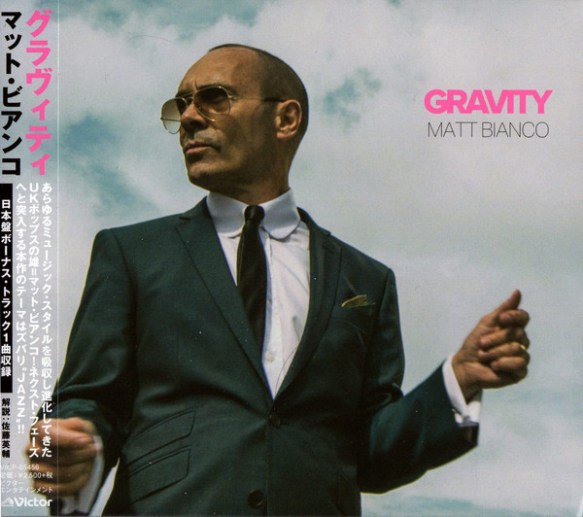
It’s only been 7 months since Mark Fisher’s death, and we already have new Matt Bianco album. I didn’t know what to think about that. For me, Matt Bianco meant Mark Fisher’s catchy keyboard harmonies and Mark Reilly’s characteristic voice (I know, there was a different Matt Bianco with Danny and Basia, but that never did it for me). My favourite MB tunes were all Fisher/Reilly collaborations, so with him gone it was difficult for me to imagine what a Fisherless MB album would sound like.

While Fisher was ill, Reilly already collaborated with the dutch alternative jazzers New Cool Collective. I quite liked what they came up with: the album had some cracking tunes and I liked the New Cool Collectives idiosyncratic melange of brass and rhythm. So for the next Matt Bianco album Reilly again switched musicians: out are long time collaborators and studio heroes such as Tony Remy, Andrew Ross, Nick Cohen, Simon Finch, in are Graham Harvey (him of Incognito), Magnus Lindgren (Scandinavian Sax wunderkind), Dave O’Higgins (ditto, just not Scandinavian and already on Gran Via’s ‘Victim of Love’) , Geoff Gascoyne (British jazz bass legend) and Martin Shaw (Trumpeter extraordinaire). Elizabeth Troy – who got the background vocals job after Hazel Sim left) was allowed to stay.

So, all new personnel, new sound? Definitely, yesyes.

Out are the sequencers, the drum computers and electronic percussion. No more layered synthesizer harmonies, appregiatos and funky rhythm guitars. This is Reilly accompanied by classic acoustic jazz band, doing a Kurt Elling impersonation. This is not meant as a slight, as it works really well. A longstanding joke between the three remaining Matt Bianco fans is that you usually get two or three cracking songs per album (that’s ten pound per song if you order the Japanes import), and Reilly and his collaborators don’t disappoint: ‘Heart in chains’ and ‘Before it’s too late’ are excellent, and up there with the best of 30 years of Matt Bianco.

The album has been on heavy rotation at Chez Fordiebianco’s for 6 weeks now (tolerated by the best girlfriend ever – some sort of compliment, I’m sure) and I am still enjoying it. If you think about it, becoming more jazzy was always on the cards as Fisher and Reilly became more mature. HiFi Bossanova was already halfway there, so it feels natural that Reilly and the Jamie Cullen Band (which is what his marry men apparently are) have just progressed to where they should be.

This is a beautiful album that is beautifully produced and as such deserves a first class hifi system.

Nice one, Mark.

Carole King: Tapestry

P1020777

If you’re in your forties, it’s pretty likely that you have been exposed to the songs on this album since you were very small, be it on the radio by Ms King herself or in covers by your favourite bands when you were a spotty teenager. It’s even more likely that your parents had a copy. It’s one of those seminal works of art in contemporary western cultural history comparable to Warhol’s ‘Campbell Soup’ paintings. For me it’s one of the best albums of all time, next to ‘Rumours’, ‘The White Album’, ‘Nevermind’, ‘Pet Sounds’, ‘The Lexicon of Love’ and of course Matt Bianco’s eponymous second album. There is not a single bad track on the album, but of course the outstanding ones are the much covered ‘I feel the Earth move’, ‘So far away’, ‘It’s too late’, and ‘You’ve got a friend’. I’ve only bought the album a few years ago second hand in a charity shop in Oamaru, and had listened from time to time and always enjoyed its seventies appeal and its sonic simpleness but the copy I had was so scratched that soon enough it wasn’t possible to play it anymore. My digital copies were still intact, but boy, it did sound limited.

P1020779

Since I added a SACD player to the living room’s audio setup, I have slowly but surely bought SACD versions of my favourite records to the collection, so I ordered Mobile Fidelity’s SACD edition to replace the old silverling and, suck me sideways: what suddenly came out of the Klipschs was nothing like the muddled, ancient seventies stuff that I was used to. This was suddenly an intimate, very vivid live performance in my living room, with a piano player in the middle. During ‘So far away’ I suddenly picked up the drummers problems with keeping his hihat and bass drum synchronised (I actually never noticed any drums on that track) and the beautiful flowing basslines of Charlie Larkey. Never before did a SACD make such a difference and raise a thick curtain of acoustic muffling to reveal an amazing production. dp

‘Tapestry’ is an amazing album that is close to perfect, and with this edition Mobile Fidelity has produced an absolute stunner. Has been running non-stop for hours now.

Runrig: Amazing Things

IMG_0048

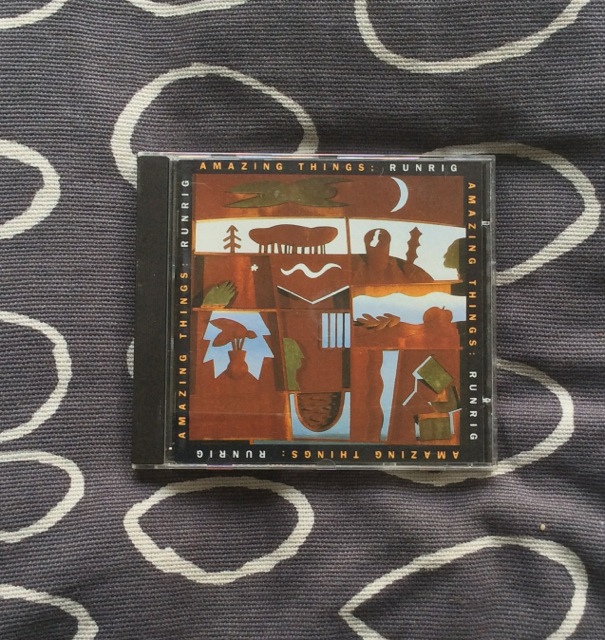
Runrig was one of the reasons that I physically was much fitter in the nineties. As their songs were inexplicably played on German radio station SWR3 on an all too frequent basis, it was one of the most common reasons to engage in a mad, fast dash to all radios in the vicinity to switch the channel as quickly as possible to get rid of their aurally upsetting noodling.  I have never understood the German fascination with Runrig in the nineties, but then I didn’t get the David Hasselhoff thing or the Scorpions either. I have probably spent too long to in the UK to be devoid of an irony switch.

I was given this CD by a true fan. He recites his Runrig live experiences as some of the most profound of his life, at which stage his long suffering girlfriend would normally start to gag and roll her eyes while the conversation often would die down and enter one of these embarrassing pauses that can only be changed with either a comment about the weather or last week’s performance by Sheffield Wednesday. He insisted playing it all evening that night I was given this poisoned chalice and since then it has been sitting in my CD-collection. Unheard for 13 years.

Until today.

I listened to it intently while writing a paper for the Open University which only inspired me to focus more on my work. There was much celtic troubadouring, fiddles, bagpipes, electronic percussion and a singer who obviously took himself very serious. Lyrics like ‘Lifetimes in memory, flesh being born: but this is the age of invisible dawn’ littered the album. It sounded like a drunk Scotsman trying to sing the karaoke version of some eighties Bon Jovi material with added ‘celtic’ bits in it.

Bill Bailey famously called music like this famously ‘some old celtic bollocks’.

I agree. I think I will use this as my new favourite coaster to avoid coffee stains on the furniture.

IMG_0050


Swing Out Sister: Live at the Jazz Cafe

Design? Who needs Design? We have Word for Windows.

Design? Who needs Design? We have Word for Windows.

There was a time in the eighties when suddenly having a jazzy, retro feel to the records was perfectly fine. Sade was channeling Astrud Gilberto, both The Style Council and Matt Bianco had a go at Samba and Working Week sounded like they could be from Rio (even though they were Londoners). The over all term was ‘SophistiPop’, and Swing out Sister (SoS) with their Bacharach/seventies big string sound fitted right in there. Their first album ‘It’s Better To Travel‘ sold reasonably well on the back of “Breakout’ but the SophistiPop thing was over after a year or two, and the representatives of the genre soon decamped to Japan where they like that sort of thing (many a SophistiPop band that you thought hadn’t existed for thirty years is still around making new albums on the back of their popularity in Indonesia. No, really).
20140418_193745

Some stimulating prose right there

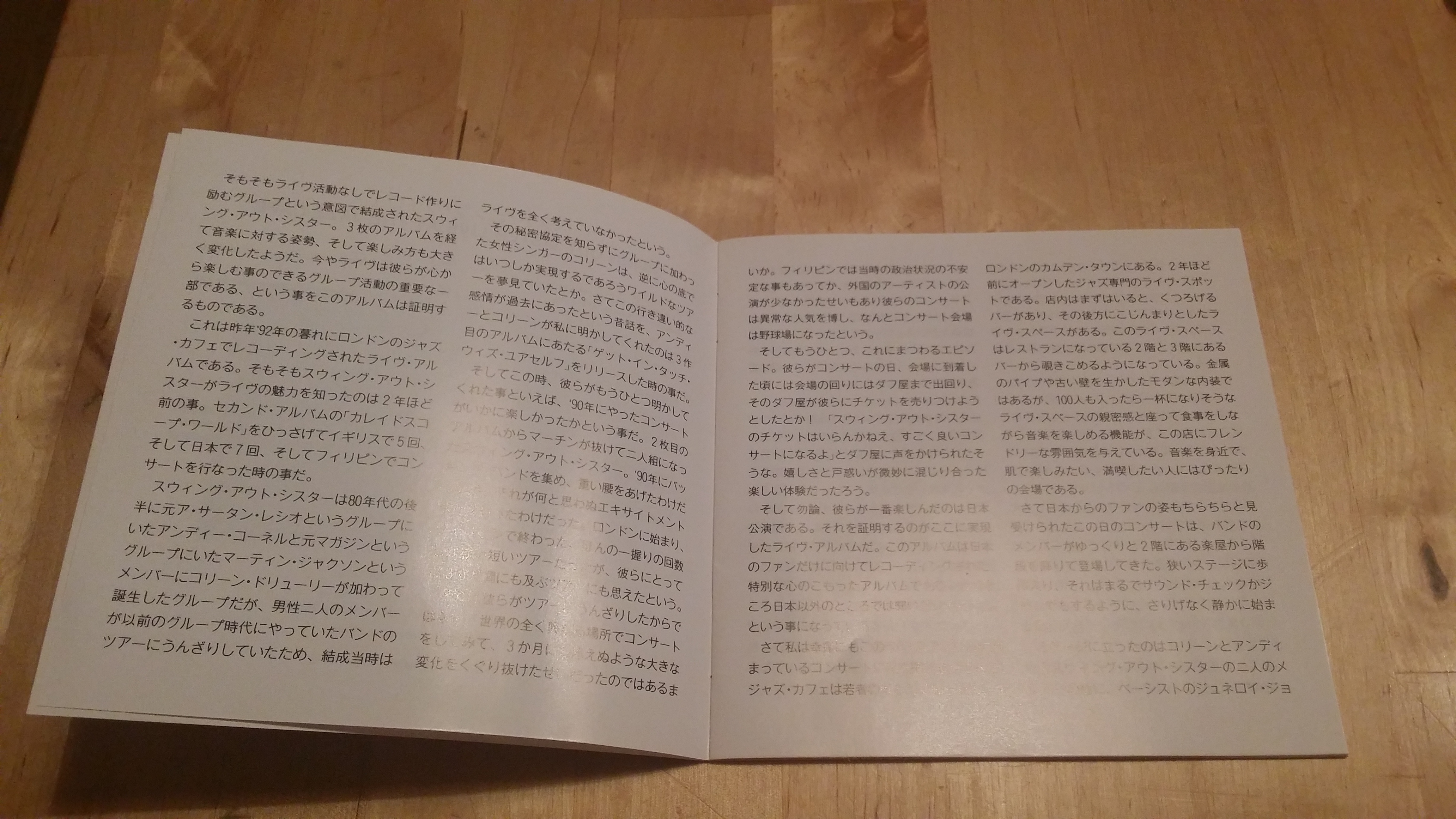
So in 1992, with 3 albums under their belt, SoS decided to release a live album for the Japanese market, recorded at the Jazz Cafe in Camden (ironically still Matt Bianco’s London live home in 2014) with a ten piece band. With their original arrangements being rather string heavy this feels quite stripped back (although there’s still quite a bit of midi background synth fill: the keyboarder has after all only 2 hands), but the vocal arrangements are spot on, the brass sounds crisp and the rhythm section is excellent.

So, these guys are obviously good musicians, but what about the music? Well, there’s the rub. In the humble opinion of this crtitic, their material doesn’t really lend itself to live performances: most of their material is midtempo and really benefits from large orchestration and elaborate arrangements.  On this album they even reduce the tempo on some of their normally livelier songs even more, so the whole thing sounds rather treacleish (technical term). I don’t think much dancing was going on at the Jazz Cafe during the recording. Probably more gentle nodding of heads.

Which really defeats the purpose of a live album. You really want to hear your favourite songs in a feverish, exciting atmosphere, but this sounds more like the recital of Virginia Woolf at the Women’s Institute in Torquay.

Which probably explains why I hadn’t listened to it for 20 years.