The daily Oppressor: Fiji’s junta at it again.

Yesterday the Fijian junta of General Bananarama reinstated a state of emergency. Taifun? Earthquake? Armed rebellion?

No.

It’s because the ousted ex premier Laisenia Qarase incites unrest by ‘repeatedly going to the media, misinforming the public of harassment’ (Lietenant-Colonel Mosese Tikoitoga, chief of Fiji’s land forces in this Radio New Zealand interview).

So, kids: if you ever get harassed and threatened by the fijian military and complain about it to the international media, don’t be surprised if the rest of your country will be put under oppressive military law for all your whining.

Gosh, what a bunch of eejits.


Feeling harassed: Commander Bainimarama

Ali Panah and New Zealand’s problems with immigration

When it comes to immigration, New Zealand is strangely torn: on one hand the government is happy about every professional who is plugging the personnel deficits in the public services (doctors, engineers) and welcoming thousands of seasonal farm workers, but an Iranian asylum seeker whose employer and workmates vouchsafe for his excellent work ethic is supposed to be deported. Weird, ay?

Ali Panah left Iran 5 years ago and converted in South Korea to Christianity before applying for asylum here in NZ. After his Asylum was refused he was imprisoned and to protest his deportation he started a hungerstrike 2 months ago he just stopped.

Now, my query: If this guy has been paying his taxes for the benefit of the state while he was working why not just give him a work permit and save the money the legal proceedings and extradition process is going to cost? Even if the whole Christianity stunt is a fake, at least NZ has another hard worker and tax payer.

Problem solved.

Bank Holiday in Aberdaron

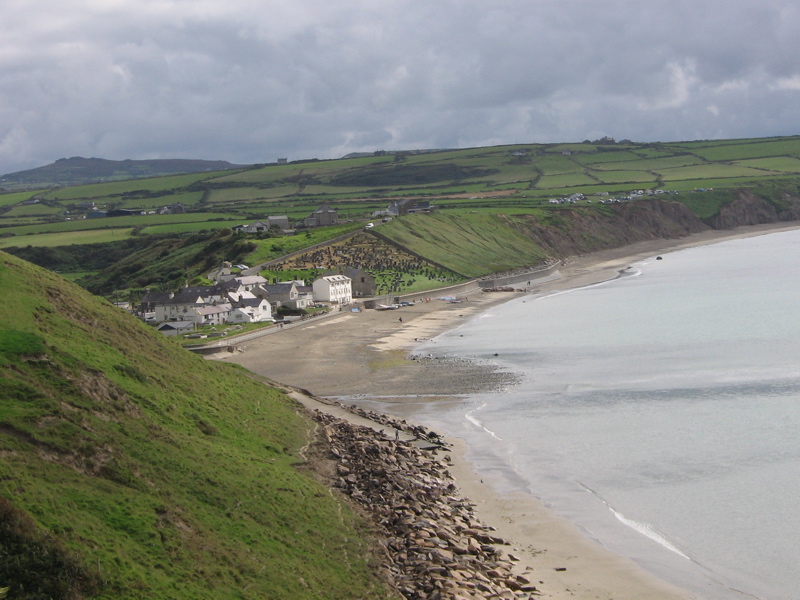
Last week I wanted to get out of the fifth circle of hell, er, Germany for 3 days to get some fresh air, so I took the best girlfriend ever to one of my favourite destinations in this world: Aberdaron, a small village on the end of the Llyn peninsul in Wales is one of the most pleasant places to have a nice, quiet weekend. What I didn’t know was: it was still Summer Holidays and it was the Bank Holiday weekend. So, it was neither quiet nor isolated, but full of burned tourists from that land in the east the Welsh hate with deep conviction. I give you a hint: it’s not Germany. Anyway the weather was nevertheless perfect, and after we compensated the fact that all restaurants were full with two pints of lager and a packet of crisps each (well, we DID pass Runcorn earlier) on the beach, we spent the next day hiking on my favourite track.


img_1065.jpg

Next day we drove north and checked out some of the larger dwellings in North Wales, being quite surprised by Bangor and its rather nice university.


Next morning back via the hilariously named John Lennon Airport in Liverpool, with an Easyjet flight leaving at 07:10, made easier thanks to the nice people at the Holiday Inn Express at the Airport.

….and I don’t know why, but Easyjet is so much nicer to fly than Ryanair. Maybe it’s the colour, or maybe because the cabin personnel was actually trained to smile.

Impressed in Singapore

Hiho,

a nicely kitted out 777 dropped us yesterday afternoon at Changi Airport, and a shuttle whisked us to our temporary home at the Shangri-La, before we head further north west wards to Germany tomorrow. So today was a day of sightseeing and soaking up the atmosphere in Singapore. What an impressive place this is. As someone who is used to living in urban environments, I was surprised by its airyness. Nothing like the crampedness of London, the gloom of Berlin or the dirt of Sao Paulo. Instead a reasonably modern urban space interspersed with the heritage colonial buildings of the British and numerous waterways.

It is of course impressively clean and populated with an interesting mixture of Chinese, Malay, Indians and Europeans, giving it a rather cosmopolitan flair. Everything seems to work very well, including an excellent public transport system and the place feels inherently safe. The best girlfriend ever joked that it is so much easier to create a working infrastructure in a de-facto one-party state ruled by technocrats because you don’t have to take any heed of the pesky opposition. Reading the Straits Times certainly reminds you of the Pravda or the Neues Deutschland from the olden days, with glorifying reports from the government prominently on the first few pages. Apparently the Economist Intelligence Unit calls the place ‘partly free’, which is probably a pretty apt description. Nevertheless, the place is certainly buzzing and all that authoritarian ruling seems to have made Singapore a desireable place to live, which puts me old liberal in tough spot: Authoritarianism: bad. Good public transport, proper housing, advanced environmentalism: good. It’s a bit like congratulating George Bush on his drug subsidy bill. You do it with gritted teeth.

Talking (again) about public transport: when we walked through the MRT, Singapore’s metro system, we noticed strange, shiny metallic lines on the floor. This must be the coolest way of telling the visiual impaired where to go:

img_1000.jpg

It’s got texture, it’s linear and it’s a bloody brillant idea. Maybe our European/American colleagues should take notice?

Anyway: gotta go.

More in two days from the fifth circle of hell, er, Germany.

Justinian’s Flea

Ambitious historical narrative by first time author and autodidact

I stumbled over this book while reading The Economist’s literature section and, while getting a mixed review, was fascinated by what it set out to be: a detailed explanation (or study) of how the bubonic plague prepared the grounds for today’s Europe. Written by a first time author, this sounded too interesting to be ignored, and I wasn’t to be disappointed.

It is unfortunate that there’s almost nothing known about Rosen: the only thing we know is that he was an executive at Schuster & Schuster, a publishing company, and this is his first book. So whether Rosen has always been a passionate amateur historian or actually has a postgraduate degree in history is unknown. He nevertheless exhibits a gift for written word that is remarkable, as his prose is effortless and shows a decent sense of humour.

‘Justinian’s Flea’ is not the work of a historian, as it’s far to enjoyable to read. The guy was a publisher, and after editing thousands of works he knows what a reader appreciates. He tells us about the world that came before and after Rome’s last great Emperor, Justinian and the period in history during this fascinating man’s reign. This outstanding theologian, lawmaker and shrewd diplomat oversaw the expansion of his empire around the mediterranean, gave the world a first civil law codex and manifested the orthodox Christian church in the east of Europe. In constant war with numerous barbaric factions in the west and continuously threatened by the Persians in the east of his empire, his diplomatic skills and the military genius of his generalissimo Belisarius kept the empire together until Yersinia Pestis decimated his population by around 25 million and made way for the protonations of the middle ages.

The scope of this book is breathtaking: Rosen delves into theology, law, genetics, epidemiology, history and philosophy, but never breaks his effortless style, making the whole thing immensely readable. Mary Beard, the Sunday Times’ reviewer, critises his lack of depth. Thirty pages of literature references make this statement highly doubtful, but if Beard equals depth with classic academic unreadability, I know what I prefer.

Justinian’s Flea is an amazing book and belogs to sit proudly next to that other master of the scientific narrative, Jared Diamond. Just like Diamond, Rosen manages to write about a highly scientific subject with a verve and style that makes his book impossible to put away.

Highly recommended.

William Rosen: Justinian’s Flea. Johnathan Cape,pp367