How much laptop can you get for 160 Euros?

You know the dilemma: you are going on holiday, want to take a laptop to potentially do a little bit of light work or even some browsing, but really worry about what happens when your expensive piece of aluminium from Cupertino is stolen (or, in my case, left on a train), potentially full of sensitive information (though to be fair to Apple, cracking a locked down MacBook is pretty tricky). The alternative is taking something with you that might be less disastrous to loose, so maybe an old machine or, in my case, the cheapest new laptop with a 14 inch screen one can find. Step in a large South East Asian provider of electronic goods and an unnamed seller of reasonably priced laptops. In this case a 14 inch laptop with an alleged Intel N3700, 16MB of RAM and 128MB of SSD for 160 Euro. At this price one has to expect a bit of subterfuge, and indeed the processor was a slightly slower (though newer) X5-E8000 and the RAM turned out to be 8MB, but hey, it arrived on time, had Windows 11 on it and worked. Windows 11 laboured a bit with a 9 year old processor, so Debian 12 came (as ever) to the rescue. LXQt runs smoothly, video/audio playback and streaming works well and all internal hardware instances are supported out of the box (so to speak). Work works (?), as its quick enough to let Firefox run the office applications in the browser (if Libre-Office is not your thing).

So yes, thanks to Linux it’s perfectly doable to use a light, cheap but underpowered laptop for the price of an Apple ac-adapter for work and (a little bit of) play. If it’s sensitive information you’re carrying around, the encrypted home folder will sort that.

Just don’t have ‘user’ / ‘password’ as your login credentials.

a silver laptop with a linux desktop

Classic Disco From Utrecht

So, I have a soft spot for classic Disco. I know that admission (in the seventies’ US of A) might have me ending on a funeral pyle during a break at a National Football League game, but in 2025, I think it’s safe to admit this. I particularly like the Philadelphia, MFSB inspired sound of percussion, funk and a lush and generous orchestration, with its epitomy Dan Hartmann’s ‘Relight my Fire’. I remain steadfast in my opinion that this is the best example of how to use orchestration to enhance and add some drama to an already existing excellent song (though the Manic Street Preachers came close with ‘Design for Life’ and ‘Everything must go’ in a completely different genre). It’s also one of the best songs of all time, full stop. The Take That version pales in comparison and did the song no favour. I always fancied arranging this song for a live orchestra/band/choir, but unfortunately lacked both the talent and the cash to hire 100 musicians, singers and a recording studio big enough to put them all in.

Well, step up the orchestra and choir of the Hogeschool voor de Kunsten Utrecht and arranger/conductor Chris de Bruin, who delivered this as project towards his graduation. While the arrangement doesn’t have the fluidity and perfection of Hartmann and MFSB (particularly the 11 minute version), the video of de Bruin’s project is just so joyful and catchy, that I haven’t been able to stop watching it. A true gem of the Interwebs.

And while we’re at it: their version of Barry Manilow’s Copacabana (arranged by the amazing Emma Wieriks) is just as good. You can feel the fun the musicians had while making this oozing through your screen and speakers.

Makes me want to throw in my day job and go back to university, studying composition at the HKU. Ironically, we recently visited Utrecht for the first time. What a beautiful place with a great quality of life.

Here’s a playlist from some of this team’s other works. Well worth checking out.

The Interstellar Age

Since my first encounter with Star Trek in the early seventies, Astronomy, Planetary Science and Astrophysics were all academic careers that I secretly coveted. Wouldn’t it be amazing to slowly but methodically entangle the secrets of the universe with a bunch of like minded people or continuously improve the technology needed to assess the necessary data. In other words, become a boffin.

It unfortunately turned out that I was far too lazy to put the work in to become adequate at either physics or math, so by the time I was ready for university I knew that this was not a realistic career to pursue. Today I know that it that it takes ages to get through grad school, that it is pretty tricky to become a PhD student in the necessary field and that you get paid peanuts as a post-doc (if you can get a job at all). So, probably the right decision to rather watch sci-fi and read about space exploration than actually be involved with it. I rather pay my yearly dues to the Planetary Society, listen to the right podcasts and marvel at the work the boffins crank out.

With the remaining members of Voyager 1&2’s science and engineering team celebrating 40 years since the two probes blasted off, the New York Times featured this event quite prominently in its science section, with a particularly lovely article about the remaining engineers by Kim Tingley. I have been following the fate of the two probes for decades as well (the advent of the internet has helped) and thought recently it would be nice to get a nice roundup of their history, so I bought Jim Bell’s book ‘The Interstellar Age’ . Bell is an accomplished academic and heads his own department at Arizona State University (and is the president of The Planetary Society), so you’d think he’d make a top notch author for a book on the Voyagers.

Well, unfortunately, he isn’t. I have no idea why, but rather than focusing on the scientific wonders and engineering issues that such a project discovers, he uses the book to frame his own personal academic career within the timeline of the two probes. Hell, it takes him 41 pages to begin the actual story. Interspersed with the history and some of the findings of the probes there are semi-funny anecdotes of him being a helpful grad-student, but then he omits the story around Voyager1’s faulty radio receiver before the Jupiter flyby. He also spends far too long on the design of the golden records.

I got increasingly frustrated by this book. While without question a nice chap, I really wasn’t particularly interested in Bell’s career, even if it touched Voyager from time to time. I’ll now have to hunt for somebody else’s account of those two technological marvels.

Recommendations welcome.

Jazz Under The Dome

It often astonishes me how much good music is out there, lying around in charity shops, often for sale for a pittance. I often wondered what it must feel like as an artist to find the product of  years of hard graft in a bargain bin in a charity shop, for sale for 50 pence. Probably a bit dejected, I would assume.  A few weeks ago I purchased about 20 or so Jazz records from a charity shop (paying a few bob more than was expected of me) and took them home for sorting. The vast majority turned out to be the usual dixie albums by various pop and mum’s cousin from down the road bands that somehow scraped enough money together to make a record, but a few where genuine discoveries. One of them is the impressive ‘Jazz Under The Dome‘ by the Freddy Merkle group. Stylistically to be found around Miles Davis’s ‘Birth of the Cool’ (though harmonically a bit more conservative), this is a collection of songs composed, arranged, conducted (from the piano, which he plays on the sessions) by one Bill Potts. An excellent feature on Bill Potts by Eddie Dean in the Washington City Paper gave me a bit of background and led me to discover a whole range of amazing jazz from the late fifties: Lester Young’s sessions with Pott’s trio in some dingy nightclub in D.C. Potts recorded with his own gear, and ‘The Jazz Soul of Porgy and Bess‘, a commission from United Artists. The guy had some serious jazz chops, and as I’ve been listening to his music for the last 4 hours I can thoroughly recommend his oeuvre.

That’s where the true fun lies when taking old second hand vinyl home: one album will open up a narnia of cool new stories, biographies and much more music. So for tonight the house is swinging to the tunes of Bill Potts and his various co-conspirators.  And thanks to the much maligned Spotify I didn’t even have to go through baskets of second hand vinyl to find them.


China delivers. Again.

Hello!

The tubification of the household continues. After the introduction of one of Aric Audio‘s pre-amplifiers to the livingroom’s audio chain I was on a roll: what I needed now was similar tubey, valvey goodness for the man cave upstairs. I already had a lovely little pre-amplifier from the nice man at BTE-Design and another chunky Marantz SM-80 to drive the rather power hungry KEF LS-50s, but what was missing was a DAC that could deliver tubey, valvey goodness and decode the bits and bytes coming from the computers in the man cave.  Many audio forums were scrutinised, hours were spend on ebay, and in the end the Xiang Sheng DAC 01-A, a tube DAC and headphone amp was chosen. Recently updated with a new XMOS-U8 USB interface supporting DSD64 and 128, this was future proof for more high res music and backwards compatible enough to play my old 128k MP3s from 2001. Doukmall from Ebay again delivered on time and on budget and for £150 there was really not that much risk.

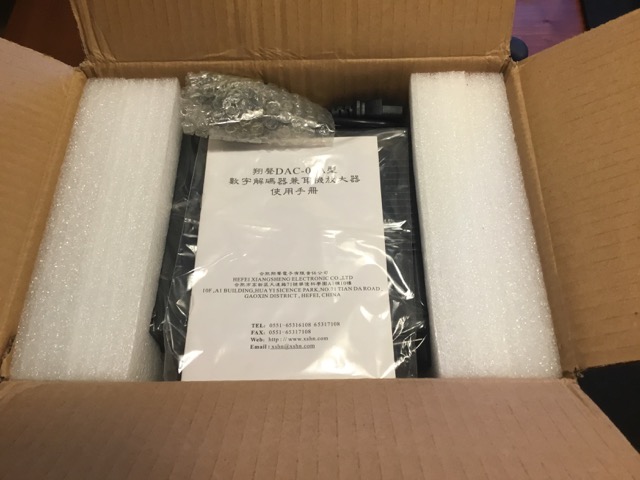
As promised, ten days later a package from China arrived, direct from the manufacturer,  XiangSheng Electronic Co in Hefei. DHL get around, don’t they?

Well packaged, with a moderately readable instruction booklet its compact and has loads of inputs:

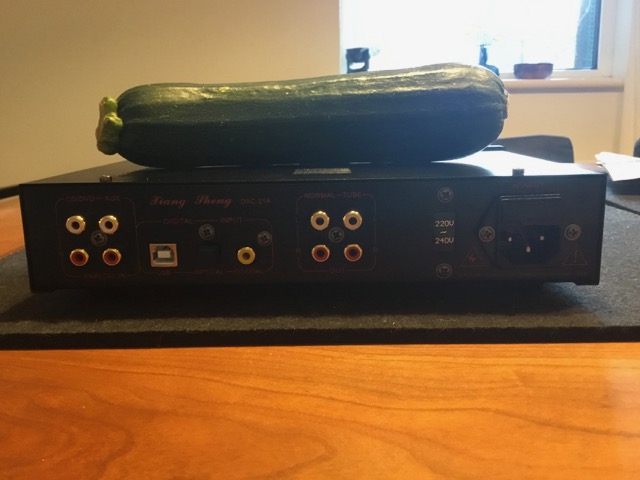
USB, optical, coax and two analog inputs. The outputs are straight analog or tube enhanced.

Sorry, didn’t have a banana at hand.

If you want to, you can open it up and switch the jumpers to turn it into a pre-amp instead, rendering the headphone amp obsolete. Xiang Shen’s custumer service was quick to help with any questions and the unit has been working faultlessly ever since it arrived. To play higher resolution tracks via the USB 2.0 interface, you’ll have to download XMOS’s driver which is ubiquitous on the net and which works well on Windows 10.  It sounds brillant, with significant improvement to my last DAC, even though that was significantly more expensive. Another win for China MidFi. I certainly bow to our new Chinese MidFi Overlords.